Best places to stay on the Costa Rica Caribbean coast
Why the Costa Rica Caribbean coast is a very specific choice
Dense jungle leaning straight over the sand, reggae from a bar in Puerto Viejo drifting through the trees, howler monkeys louder than any alarm clock. The Caribbean coast of Costa Rica feels nothing like the Pacific side. It is slower, more humid, more intensely green, with a strong Afro-Caribbean culture that shapes food, music, and the rhythm of the day.
Travelers considering a hotel on the Caribbean side of Costa Rica usually hesitate between this coast and the better-known Pacific resorts. The trade-off is clear. You swap long strings of large star hotel complexes for smaller properties hidden in gardens, closer to the beach line and to daily life in villages such as Puerto Viejo de Talamanca, Cahuita, or the hamlets around Cocles and Punta Uva. You gain character and proximity to nature, but you lose some of the polished resort infrastructure.
For a first stay in Costa Rica, this region suits guests who value atmosphere over formality. Expect gravel roads, sudden tropical showers, and the constant background sound of insects. Expect, too, some of the most beautiful stretches of coast Costa Rica offers, especially between Playa Negra and Punta Uva, where the forest still reaches the water in many places. If you want a hotel Caribbean Costa Rica experience that feels genuinely local, this is where to look.
Mapping the main areas: Tortuguero, Cahuita, Puerto Viejo, Punta Uva
From north to south, the Caribbean coast breaks into distinct zones, each with a different type of stay. Tortuguero, on the northeast coast, is only accessible by boat or small plane and sits within a national park of canals and flooded forest. Here, you do not walk out of your hotel to a road; you step onto a dock. It is ideal if you want wildlife first, beach second.
Further south, Cahuita lies roughly 40 km from the port city of Limón along Route 36. The village hugs the entrance to Cahuita National Park, where a flat coastal trail runs for about 8 km under sea-almond trees, with white-sand coves on one side and dense forest on the other. Hotels here tend to be low-rise, surrounded by gardens, and within a short drive of the park’s main entrance near Kelly Creek.
Puerto Viejo de Talamanca, about 15 km beyond Cahuita, is the liveliest hub on this coast. The main street, running parallel to the beach, concentrates restaurants, bars, and small hotels, while the road continues southeast toward Cocles, Playa Chiquita, and Punta Uva. Each of these beaches has its own micro-atmosphere: Cocles with its surf break, Playa Chiquita with quieter coves, Punta Uva with postcard-level scenery. Choosing where to stay Caribbean side often means choosing between these pockets of character rather than between individual hotels.
What to expect from hotels on the Costa Rica Caribbean coast
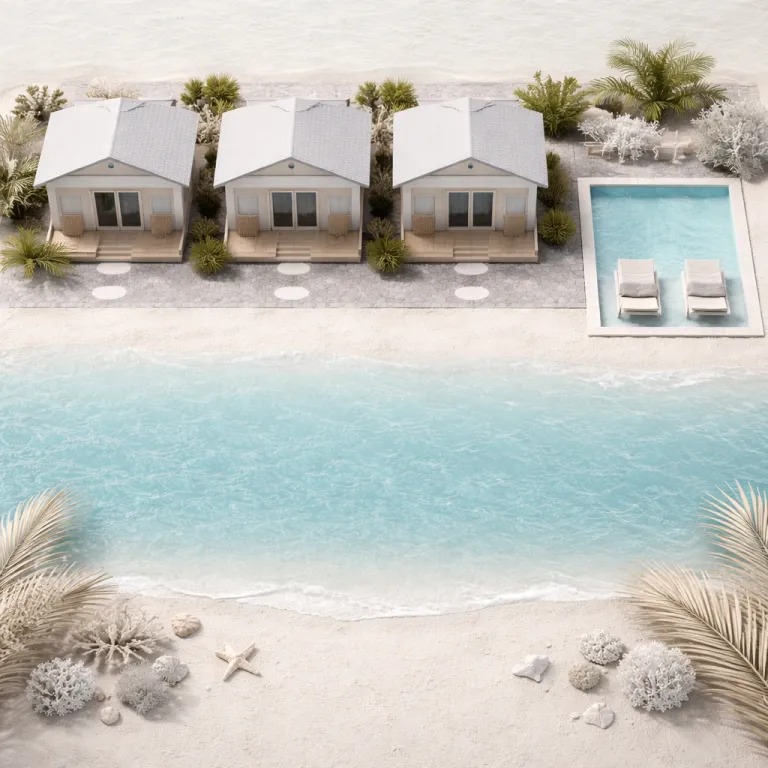
Rooms on this coast often feel more like beach houses than classic city hotel units. Think high ceilings, fans, and wide verandas rather than sealed, air-conditioned boxes. Many properties are set back a few metres from the beach behind a line of palms, with sandy paths leading to the sea. Outdoor swimming areas, when present, are usually compact pools framed by tropical plants rather than vast resort-style complexes.
On the Caribbean coast of Costa Rica, the line between garden and jungle is thin. You may see sloths in the trees above the parking area or agoutis crossing the lawn at dusk. This immersion is part of the appeal, but it also means you should expect some humidity, the occasional gecko on the wall, and the soundtrack of frogs at night. Guests who prefer a fully controlled indoor environment sometimes find this challenging.
Service style tends to be informal but warm. Staff often live locally and know the coast intimately, from the calmest swimming spots near Punta Uva to the best time to walk the trail in Cahuita National Park. When you check availability, pay attention to whether the property offers simple rooms, suites, or stand-alone units, and whether there is an on-site restaurant or you will rely on the dining scene in Puerto Viejo or Cahuita.
Choosing your base: Puerto Viejo, Cocles, Cahuita or Tortuguero?
Staying in or near Puerto Viejo suits travelers who want energy. You are close to bars, live music, and a wide choice of restaurants along the main road and side streets such as Avenida 71, which runs back from the beach. Hotels here range from simple guesthouses to more polished options with a swimming pool and landscaped grounds, but the village remains compact enough to explore on foot or by bicycle.
Cocles and the stretch toward Playa Chiquita offer a different rhythm. The road is lined with trees, and many hotels sit on small side lanes leading toward the beach, giving a sense of seclusion while still being only a few kilometres from Puerto Viejo. This area works well if you want to surf at Cocles in the morning, then retreat to a quieter setting in the afternoon. It is a good compromise between access and calm.
Cahuita feels more traditional and is the better choice if your priority is easy access to the national park’s coastal trail and coral-fringed beaches. The village is smaller than Puerto Viejo, with a relaxed main street and a handful of places to stay within walking distance of the park entrance. Tortuguero, by contrast, is a destination in itself: you come for the canals, the turtles in season, and the sense of isolation. Here, you typically stay in a hotel that includes guided boat outings and walks inside the national park, with the beach as a wild backdrop rather than a classic swimming spot.
Key details to check before booking your Caribbean stay
Before confirming any booking on the Costa Rica Caribbean coast, verify the exact location on a map. Distances that look short can feel longer on narrow, sometimes potholed roads, especially at night or in heavy rain. A hotel described as being in Puerto Viejo might in practice sit several kilometres away along the road toward Cocles or Playa Negra, which changes how easily you can walk to dinner or the beach.
Parking is another practical point. Not every property has a large, dedicated parking area, and some rely on small on-site spaces or roadside spots. If you are driving the coast Costa Rica route from Limón down to Puerto Viejo and beyond, knowing whether secure parking is available can influence your choice, particularly in the busier parts of town. Guests arriving by public bus will care more about walking distance from the stop on the main road.
When you check availability, look carefully at room descriptions. On this coast, “garden view” can mean anything from a manicured lawn to dense forest right outside your terrace. Some hotels offer outdoor swimming pools, others focus on direct beach access or lush grounds instead. Decide whether you prefer to be directly on a swimmable beach such as sections of Punta Uva, near surf breaks like Cocles, or within a short drive of protected areas such as Cahuita National Park or the canals of Tortuguero.
Who the Costa Rica Caribbean coast suits best
Travelers who fall in love with the Costa Rica Caribbean coast usually share a few traits. They are comfortable with a certain level of unpredictability, from sudden tropical downpours to the occasional power cut, and they value character over uniformity. They come for the mix of jungle and sea, not for a long list of standardized amenities.
If you want a polished star hotel experience with multiple restaurants, vast outdoor swimming pools, and a fully controlled environment, the Pacific side of Costa Rica generally serves you better. The Caribbean, by contrast, rewards those who enjoy walking barefoot to the beach, hearing music drift from a small bar in Puerto Viejo, or watching a thunderstorm roll in over the sea from a covered terrace. It is less about the label of “best hotels” and more about the right fit between place and traveler.
Families who appreciate nature often choose Cahuita or the quieter stretches near Punta Uva, where the sea can be calmer and the atmosphere more low-key. Couples might prefer the more secluded lanes off the main road between Cocles and Playa Chiquita. Solo travelers and surfers gravitate toward Puerto Viejo itself, where it is easy to meet people and catch early buses or shuttles along the coast. In every case, the decision is less about finding a generic hotel Caribbean option and more about choosing the pocket of coast that matches your rhythm.
Is the Costa Rica Caribbean coast a good place to stay for a first trip?
For a first trip to Costa Rica, the Caribbean coast is a good choice if you are drawn to culture and nature more than to large resort infrastructure. You get direct access to national parks such as Cahuita and Tortuguero, a strong Afro-Caribbean influence in food and music, and beaches where the forest still reaches the sand. It is less polished than some Pacific areas, but more atmospheric. If you are comfortable with a slightly wilder setting and smaller-scale hotels, it can be an excellent introduction to the country.
How many days should I plan on the Caribbean side?
A balanced stay on the Costa Rica Caribbean coast usually runs between four and seven nights. With four nights, you can base yourself in Puerto Viejo or Cahuita, explore nearby beaches like Cocles and Punta Uva, and spend a full day in Cahuita National Park. With a week, you can add a separate two-night stay in Tortuguero to experience the canals and wildlife there, then continue south for beach time. Less than three nights tends to feel rushed, given travel times from San José or other regions.
Is it easy to move between Cahuita, Puerto Viejo, Cocles and Punta Uva?
Movement along this stretch of coast is straightforward but not instantaneous. The main road (Route 36 and then the coastal road beyond Puerto Viejo) links Cahuita, Puerto Viejo, Cocles, Playa Chiquita and Punta Uva in a simple line, with distances of only a few kilometres between each. Taxis and local buses run the route, and many travelers rent bicycles for the flatter sections between Puerto Viejo and Punta Uva. If you plan to go out at night in Puerto Viejo but stay further along the coast, factor in the need for a taxi back after dark.
Can I combine Tortuguero with the southern Caribbean coast in one itinerary?
Combining Tortuguero with the southern Caribbean coast works well and is a common itinerary. Travelers typically start with two or three nights in Tortuguero, accessed by boat through the canals, to focus on wildlife and the national park. From there, they return by boat and road toward Limón, then continue south by road to Cahuita or Puerto Viejo for beach time. The contrast between the water-based environment of Tortuguero and the beaches around Puerto Viejo and Punta Uva makes the overall stay feel varied without excessive travel.
Which area is best if I do not have a car?
Without a car, Puerto Viejo de Talamanca is usually the most practical base on the Costa Rica Caribbean coast. The village is compact, with many hotels, restaurants, and services within walking distance of the main street and the beach. Local buses and taxis connect Puerto Viejo with nearby beaches such as Cocles and Punta Uva, as well as with Cahuita further north. If you prefer a quieter setting without driving, look for a place to stay within easy walking distance of the main road and bus stops, rather than on more remote side tracks.