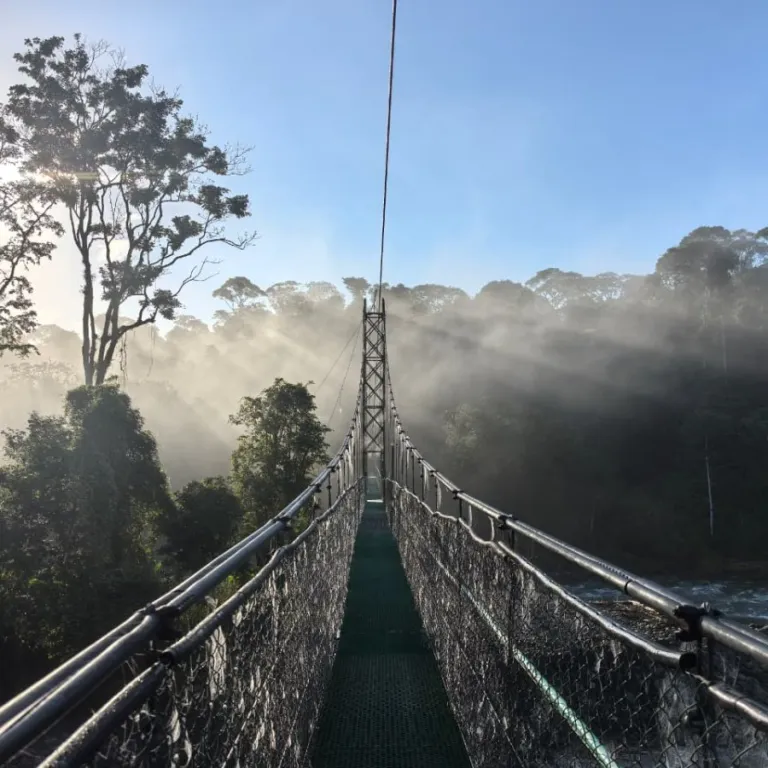
Mariela, you wear several hats as a biologist, Academic Director at Reserva Biológica Tirimbina and National Geographic Explorer; how do these roles come together in your day-to-day work to protect biodiversity in this private biological reserve along the Sarapiquí River?
My role as Director allows me to coordinate different areas, including environmental education, research, and conservation. I naturally see the connections between these different roles and work on finding ways to bring them together in practice. I don’t do everything on my own; the team at Tirimbina’s Academic Department and external researchers, collegues and friends helps me turn these ideas and projects into reality.
My National Geographic grant was specifically focused on our environmental education program, which also allows us to incorporate research findings into our educational activities. For example, last year we used research on otters that we were conducting as an input for our environmental education theme of the year: the triple environmental crisis.
We used this charismatic species to illustrate how climate change, pollution, and biodiversity loss can affect an ecosystem, in this case, the river, I can connect research, conservation, and environmental education, while making the science more meaningful and relevant to the people we work with.
Tirimbina hosts an extraordinary concentration of species — from more than half of Costa Rica’s bird species to dozens of amphibians and reptiles, some at risk according to the IUCN; in practical terms, what does it take to maintain and monitor that level of biodiversity on 345 hectares, and what threats concern you the most right now?
Although ecosystems function perfectly well without us, it is important to make sure that our actions do not negatively affect them. In practical terms, this means maintaining sustainable practices throughout our operations so that we do not harm what we are working to protect.
It also requires having staff dedicated to monitoring biodiversity, conducting long-term research, and building a strong network of partners within the surrounding communities. These are all essential to understanding the changes taking place in the reserve and responding to them appropriately.
The threats that concern us most are the loss of connectivity between forest areas, climate change, and the growing disconnection from nature that we may be seeing among younger generations. Protecting biodiversity is not only about protecting habitats and species; it is also about maintaining the connection between people and the natural world.
You’ve worked for years at the intersection of research, ecotourism and environmental education; could you walk us through a concrete example of how bird or herpetofauna research at Tirimbina has translated into specific management decisions or changes in how the reserve is used by visitors?
Yes. One example comes from our bird monitoring around the areas where our facilities are located, particularly our gardens. Through these observations, we noticed that using native plants as ornamentals around our accommodation and restaurant areas attracts a greater diversity of birds.
This led us to take a closer look at the plants available in commercial nurseries, where many of the ornamental species are exotic. As a result, we began allowing native plants to grow naturally in our gardens and propagating them ourselves. We also started working on raising awareness among gardeners and others who maintain gardens, encouraging them to recognize that “wild plants” can also be beautiful, even if their foliage is not as colorful or they do not flower as frequently as plants commonly sold in nurseries.
Our native plant garden has allowed a great diversity of bird species to live and forage close to our facilities without the need for artificial feeders. At the same time, it has enhanced the visitor experience, particularly for people who appreciate birds. So, in this case, research and monitoring helped us make a relatively simple change in how we manage our gardens, which benefits both biodiversity and the people who visit Tirimbina.
Many people fear or overlook “unattractive” species such as certain amphibians, reptiles or invertebrates; based on your experience designing educational materials, what strategies are most effective in changing perceptions so that local communities and visitors see these species as essential allies in the forest ecosystem?
I think that much of the fear comes from a lack of knowledge or from deeply rooted beliefs. For example, we often associate things that are active at night with fear or danger, and we may perceive something that looks very different from us, such as an invertebrate, as something “bad.” We also tend to make generalizations when we lack information: “all snakes are venomous,” “all bugs bite,” or “all bats are vampires.”
For me, one of the most important strategies is to break these myths and provide information about the ecological role that different species play. But this information needs to be simple, accessible, and connected to everyday life, not overly technical or full of scientific jargon. Whenever possible, I try to make it fun and engaging, because people are much more likely to remember something that makes them curious or makes them smile.
Whenever possible, we also give people the opportunity to observe these animals in a safe way, so they can see them from a different perspective rather than through fear or preconceived ideas. We also provide practical ideas about how they can coexist respectfully with wildlife.
We don’t necessarily have to make people love every species, but we can help them understand that even animals that we may find unattractive or strange deserve our respect simply because they are living beings. I think that changing perceptions starts with replacing fear and misconceptions with simple, relatable information, curiosity, and respect.
The 'Amigos del Bosque' program is deliberately intergenerational, involving children, youth, older adults and families in hands-on conservation; what have you learned from putting these different age groups to work side-by-side in the forest, and how does that change the way communities engage in long-term protection of the reserve?
Through the Amigos del Bosque program, we have activities specifically designed for different audiences, including children, youth, older adults, and families. We also have intergenerational activities where people from all these groups come together.
We have learned that encouraging interaction between generations can be incredibly enriching. These activities usually bring people together in family groups, and we have found that creating opportunities for people of different generations to share positive and meaningful experiences in the forest can help them develop a stronger connection with the site.
We also see families returning to participate in different activities and initiatives over time. For us, this is a very positive sign, because it suggests that these experiences are not isolated events. They can become part of the family's relationship with the reserve and help strengthen the connection between Tirimbina and the surrounding community in the long term.
I think that when conservation becomes something that families experience and enjoy together, it is more likely to become a lasting relationship with the place—and, ultimately, a stronger commitment to protecting it.
Looking ahead, how do you envision private biological reserves like Tirimbina evolving within Costa Rica’s SINAC framework and beyond — in terms of funding models, community co-management, and their role as climate refuges for species under increasing pressure?
I believe private protected areas make a very important contribution to conservation in Costa Rica. Not all of them are formally registered within the SINAC system, but many, like Tirimbina, have developed valuable experiences in management, good conservation practices, and creative ways of working with limited resources.
I think there is a great opportunity for stronger collaboration and communication between public and private protected areas. They can complement each other, share knowledge and experience, and work together at a landscape level, rather than seeing conservation as something that happens within isolated boundaries.
I also think we need to continue exploring more diverse and sustainable funding models for private conservation. Tourism can contribute, but it should not be the only source of income. Conservation financing could also recognize the value of ecosystem services, research, environmental education, and the role these areas play in maintaining connectivity and protecting biodiversity.
Looking ahead, I see private reserves like Tirimbina not only as places where species are protected, but also as spaces for innovation, research, education, and collaboration with surrounding communities. As climate change increases pressure on ecosystems, maintaining connected forest areas will become increasingly important, and private reserves can play a significant role as refuges and stepping stones for wildlife across the landscape.
Ultimately, I think the future of conservation in Costa Rica will depend on our ability to work together across institutional and property boundaries. The forest does not recognize whether a piece of land is public or private, so our conservation efforts should not be limited by those boundaries either.
If you could share one message with readers who may never visit a tropical rainforest, what is the single most meaningful action you would invite them to take to help protect biodiversity in reserves like Tirimbina, wherever they live in the world?
I would tell them that everything they do has an impact. If they love biodiversity and are fascinated by the beautiful species they see in our forests, whether they have the opportunity to visit a rainforest or only experience it through a documentary, I would invite them to remember that they are still connected to it.
Sometimes protecting biodiversity means committing to small, everyday actions that may seem inconvenient or even annoying: recycling, reducing waste and unnecessary consumption, creating small green spaces with native plants from your community, even if it is just a single pot, and thinking about how your everyday choices affect the natural world.
I like a beautiful idea from a song (Efecto Mariposa) by the Costa Rican band Malpaís: “Deep beneath the ocean, lunar creatures wander that I have never known, but I know that their fate will become rain along my path, and that they are part of me.” I think that is what biodiversity is about. We are all connected.
Learn more: https://tirimbina.org